
EUR/USD Price Forecast: Hawkish ECB prospects support Euro
- Euro rises against the US Dollar to near 1.1550 amid hawkish ECB expectations.
- Soft US inflation data has eased fears of a Fed interest rate hike.
- EUR/USD holds the downward-sloping trendline breakout.
The Euro (EUR) trades 0.17% higher at around 1.1550 against the US Dollar (USD) during the European trading session on Friday. The major currency pair gains as the Euro rises due to firm expectations that the European Central Bank (ECB) will raise interest rates in the policy meeting in September.
According to a Reuters poll, 57 of 69 economists said that they see the ECB hiking its deposit rates by 25 basis points (bps) to 2.50% in September.
Market experts also seem confident about the ECB tightening its monetary conditions in September to tame hot inflationary pressures.
ECB seen hiking again as other central banks face tougher choices
Analysts at HSBC highlight a growing divergence in the global policy outlook, noting that "although we expect the European Central Bank (ECB) to now deliver another rate rise in September, for other major central banks it is a much tougher balancing act." The bank contrasts the ECB’s readiness to tighten further with a more cautious stance elsewhere, underscoring the challenge facing policymakers outside the Eurozone as they weigh inflation risks against the need to keep policy on hold.
Meanwhile, traders pricing out the possibility of an interest rate hike by the Federal Reserve (Fed) in September is dragging the US Dollar.
Fed hike odds slip as softer inflation data drives dovish repricing
Analysts at Deutsche Bank highlight that the softer inflation backdrop has prompted a notable dovish shift in Fed expectations, with “pricing for a September Fed hike fell to just 35% by the close, down from above 50% on the morning of Wednesday’s CPI release.” They add that the “downside PPI surprise led to an immediate reaction in pricing for the next Fed meeting,” noting that “the probability of a September hike had been at 40% right before the release, but was down to 35% by the close.”
EUR/USD Technical Analysis
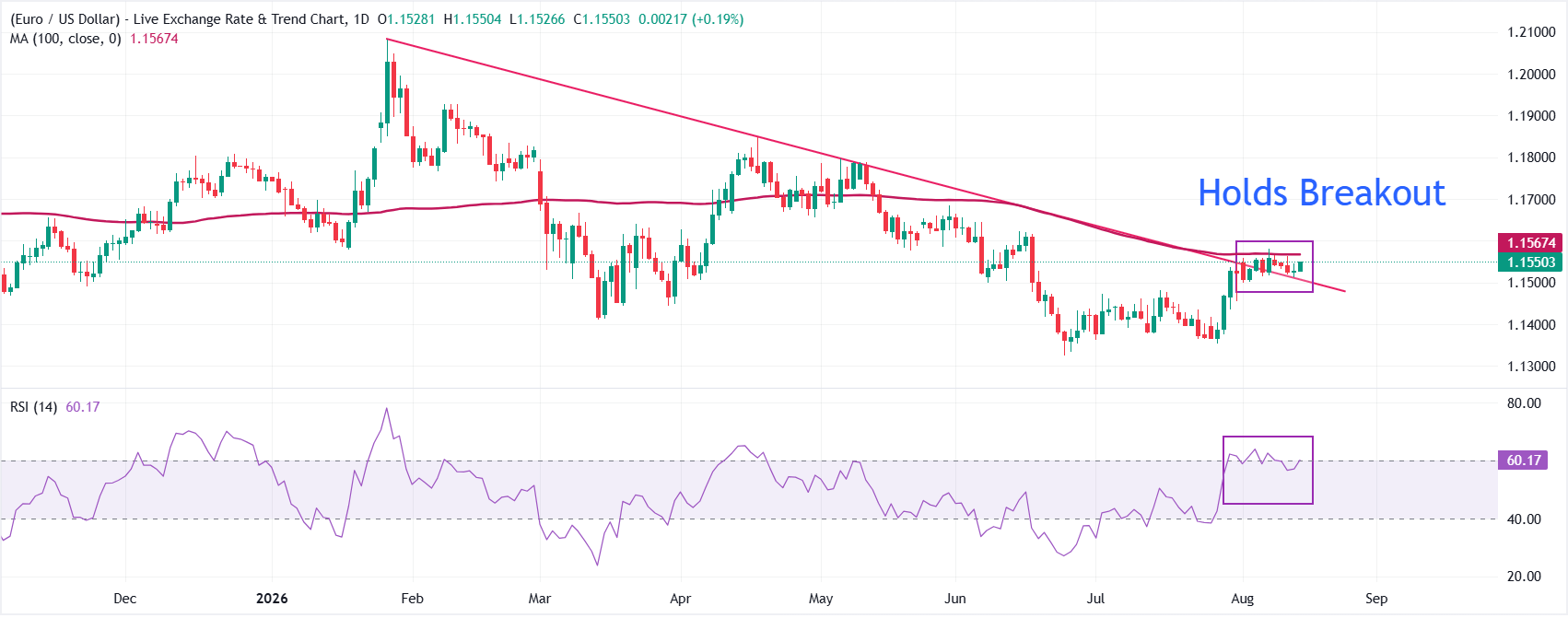
EUR/USD trades at around 1.1550, holding the downward-sloping trendline at around 1.1540, but is capped by the 100-day simple moving average (SMA), which is at 1.1567.
The Relative Strength Index (14) around 60 hints at firm bullish momentum, but this improving sentiment is yet to overcome the overhead SMA that continues to act as a ceiling.
On the downside, initial support is seen near the former trend-line break point at 1.1510, where the market previously cleared a descending resistance line, now acting as a structural floor. On the topside, the 100-day SMA at 1.1567 forms the first resistance barrier, and a decisive close above this level would be needed to ease the current bearish bias and open the way to a more sustained recovery. Looking up, the major barricade of the pair would be the round-level at 1.1600.
(The technical analysis of this story was written with the help of an AI tool. Know more.)
ECB FAQs
The European Central Bank (ECB) in Frankfurt, Germany, is the reserve bank for the Eurozone. The ECB sets interest rates and manages monetary policy for the region. The ECB primary mandate is to maintain price stability, which means keeping inflation at around 2%. Its primary tool for achieving this is by raising or lowering interest rates. Relatively high interest rates will usually result in a stronger Euro and vice versa. The ECB Governing Council makes monetary policy decisions at meetings held eight times a year. Decisions are made by heads of the Eurozone national banks and six permanent members, including the President of the ECB, Christine Lagarde.
In extreme situations, the European Central Bank can enact a policy tool called Quantitative Easing. QE is the process by which the ECB prints Euros and uses them to buy assets – usually government or corporate bonds – from banks and other financial institutions. QE usually results in a weaker Euro. QE is a last resort when simply lowering interest rates is unlikely to achieve the objective of price stability. The ECB used it during the Great Financial Crisis in 2009-11, in 2015 when inflation remained stubbornly low, as well as during the covid pandemic.
Quantitative tightening (QT) is the reverse of QE. It is undertaken after QE when an economic recovery is underway and inflation starts rising. Whilst in QE the European Central Bank (ECB) purchases government and corporate bonds from financial institutions to provide them with liquidity, in QT the ECB stops buying more bonds, and stops reinvesting the principal maturing on the bonds it already holds. It is usually positive (or bullish) for the Euro.