
GBP/USD Price Forecast: Rally pauses below 1.3700
- The British Pound edges up against the US Dollar to near 1.3640 despite the US Dollar ticking higher.
- The BoE is unlikely to raise interest rates in the near term.
- Fresh US sanctions will likely boost US Treasury Yields.
The British Pound (GBP) trades marginally higher against the US Dollar (USD) at around 1.3640 during the European trading session on Tuesday, even as the US Dollar Index (DXY) edges up, indicating strength in the British currency.
At press time, the US Dollar Index (DXY), which gauges the Greenback’s value against six major currencies, trades slightly higher to near 99.10.
The Pound Sterling gains despite market experts seeing the Bank of England (BoE) holding interest rates steady in the near term.
UK inflation surprise limited as BoE pricing eases
Analysts at Danske Bank note that UK inflation data for July were broadly in line with expectations, with headline CPI rising to "2.9% y/y (cons: 2.9%, prior: 2.6%), mainly driven by the 13% increase in the Ofgem energy price cap from 1 July." They highlight that "core inflation was slightly higher than expected at 2.6% y/y (cons: 2.5%, prior: 2.6%)," while "services eased in line with expectations to 3.4% y/y (cons: 3.4%, prior: 3.6%)." According to Danske, the combination of this inflation print and "yesterday's weak labour market data" has "taken the top off BoE pricing for the remainder of the year."
Meanwhile, the US Dollar trades higher against its other peers as investors fear that fresh United States (US) sanctions on Iran could lift oil prices higher and eventually US Treasury Yields.
GBP/USD Technical Analysis
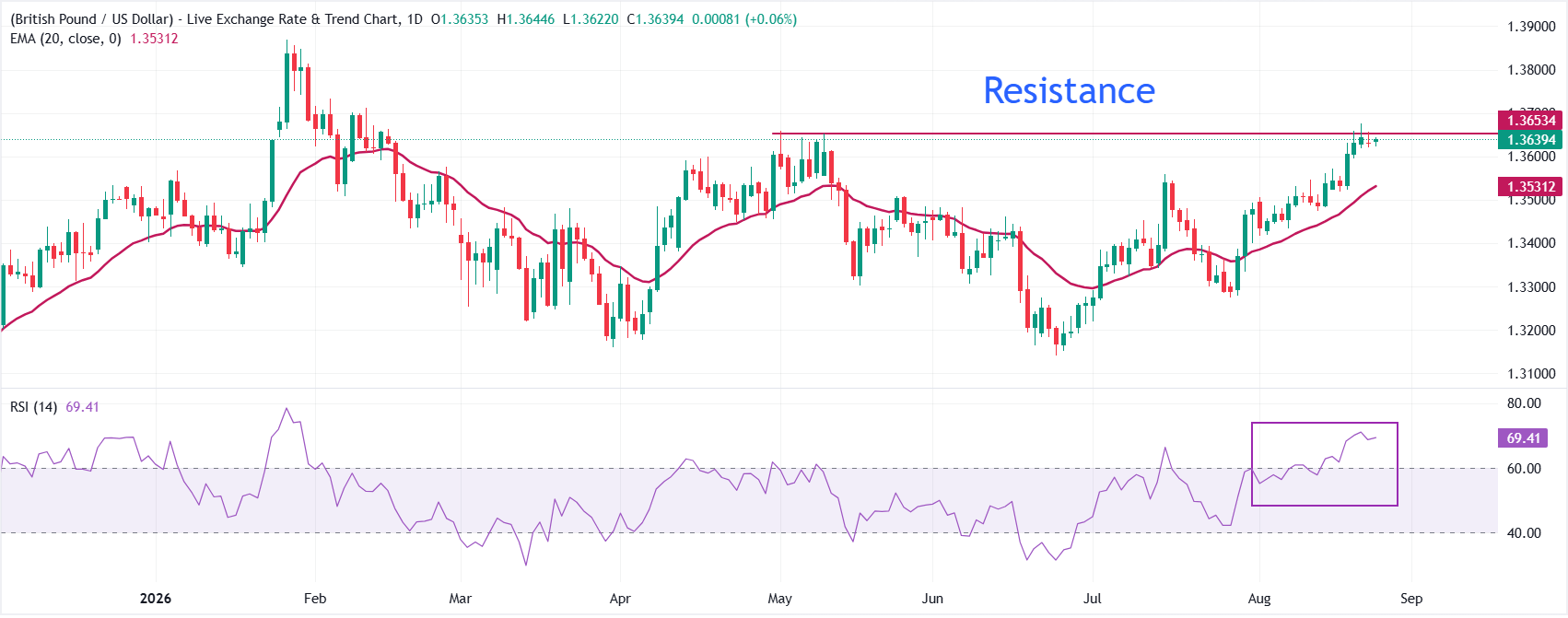
GBP/USD trades at 1.3640, maintaining a bullish near-term bias, with price holding above the 20-day Exponential Moving Average (EMA) at 1.3531, which reinforces an underlying supportive structure after the recent advance.
The Relative Strength Index (14) near 69 suggests strong upside momentum, though it is flirting with overbought territory, hinting that gains could become more gradual if buyers pause ahead of fresh catalysts.
On the downside, immediate support is seen at the 20-day EMA around 1.3530, where a break would expose a deeper correction toward prior lows not visible in the current indicator set. As long as GBP/USD remains above this moving average, the broader constructive tone is likely to persist, with any shallow pullbacks viewed as corrective within the ongoing uptrend.
Strategists at Scotiabank describe the current technical backdrop for GBP/USD as "solidly bullish," noting that after a period of range trading and "two tests of 1.3150 (April and June)," the pair now appears better poised to advance. They argue that "a sustained push above 1.3650/60 implies potential for an extension towards the 1.41 zone over the balance of the year," underscoring their view that the underlying trend dynamics continue to favour further Pound appreciation.
(The technical analysis of this story was written with the help of an AI tool. Know more.)
Pound Sterling FAQs
The Pound Sterling (GBP) is the oldest currency in the world (886 AD) and the official currency of the United Kingdom. It is the fourth most traded unit for foreign exchange (FX) in the world, accounting for 12% of all transactions, averaging $630 billion a day, according to 2022 data. Its key trading pairs are GBP/USD, also known as ‘Cable’, which accounts for 11% of FX, GBP/JPY, or the ‘Dragon’ as it is known by traders (3%), and EUR/GBP (2%). The Pound Sterling is issued by the Bank of England (BoE).
The single most important factor influencing the value of the Pound Sterling is monetary policy decided by the Bank of England. The BoE bases its decisions on whether it has achieved its primary goal of “price stability” – a steady inflation rate of around 2%. Its primary tool for achieving this is the adjustment of interest rates. When inflation is too high, the BoE will try to rein it in by raising interest rates, making it more expensive for people and businesses to access credit. This is generally positive for GBP, as higher interest rates make the UK a more attractive place for global investors to park their money. When inflation falls too low it is a sign economic growth is slowing. In this scenario, the BoE will consider lowering interest rates to cheapen credit so businesses will borrow more to invest in growth-generating projects.
Data releases gauge the health of the economy and can impact the value of the Pound Sterling. Indicators such as GDP, Manufacturing and Services PMIs, and employment can all influence the direction of the GBP. A strong economy is good for Sterling. Not only does it attract more foreign investment but it may encourage the BoE to put up interest rates, which will directly strengthen GBP. Otherwise, if economic data is weak, the Pound Sterling is likely to fall.
Another significant data release for the Pound Sterling is the Trade Balance. This indicator measures the difference between what a country earns from its exports and what it spends on imports over a given period. If a country produces highly sought-after exports, its currency will benefit purely from the extra demand created from foreign buyers seeking to purchase these goods. Therefore, a positive net Trade Balance strengthens a currency and vice versa for a negative balance.