
BoC set to keep interest rates steady despite sticky inflation
- The Bank of Canada is expected to keep its interest rate at 2.25%.
- The Canadian Dollar has given away part of its recent August gains.
- Markets pencil in just over 2 bps of extra tightening by year-end.
The Bank of Canada (BoC) is widely expected to keep its policy rate unchanged at 2.25% on Wednesday. This would be the seventh consecutive gathering with the central bank sitting on the fence.
The BoC left its policy rate unchanged at 2.25% in July, as widely anticipated. The statement and Governor Tiff Macklem said persistent increases in Oil prices could require consecutive rate hikes, although he stressed that this was not the bank’s base case.
According to the statement, the BoC sharply downgraded its Canadian growth forecast for 2026 to 0.7% from 1.2%, although the near-term picture has improved. The bank now expects annualised GDP growth of 2.5% in Q2, up from the 1.5% projected in April, before easing to 1.5% in Q3. Macklem described Q2 as “pretty solid” and suggested the improvement could prove sustainable, while acknowledging uncertainty about the recovery's durability. Indeed, economic growth is then expected to strengthen to 1.8% in both 2027 and 2028, even amid a persistent output gap, signalling that excess capacity remains in place.
Inflation, meanwhile, has been revised higher, with the BoC now expecting 2.5% in 2026, up from 2.3%, before easing to 2% in 2027 and edging back to 2.1% in 2028. Oil prices remain the main upside risk to that outlook. Macklem warned that a renewed and sustained rise in energy prices that spilt over into broader inflation could require consecutive rate hikes, while stressing that the BoC would be less inclined to respond mechanically to a temporary Oil-price spike.
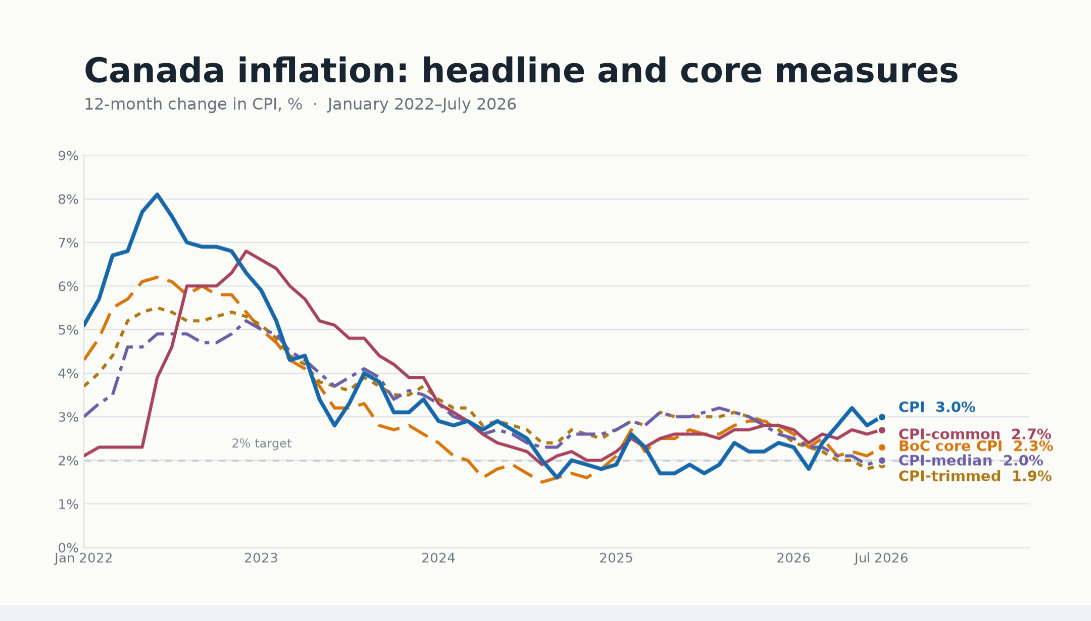
Inflation, however, remains the key watch point after all measures ticked higher in July. That said, the headline CPI rose by 3.0% in the year to July, above the previous month’s print of 2.8%. In the same direction, the BoC’s core reading rose to 2.3% from a year earlier. Furthermore, the bank’s preferred measures —CPI-Common, Trimmed and Median— increased by 2.7%, 1.9% and 2.0%, respectively, with almost all still above the goal.
When will the BoC release its monetary policy decision, and how could it affect USD/CAD?
The Bank of Canada will announce its policy decision on Wednesday at 13:45 GMT, followed by Governor Tiff Macklem’s press conference at 14:30 GMT.
Markets anticipate the central bank to maintain its current stance, with a projected tightening of just over 2 basis points by the end of 2026.
Pablo Piovano, Senior Analyst at FXStreet, points out that USD/CAD needs to clear both its provisional 100-day and 55-day SMAs at 1.3915 and near 1.4040, respectively, to attempt a move to the August top at 1.4080 (August 5), prior to the weekly peak at 1.4129 (July 28). Further up emerges the 2026 ceiling at 1.4248 (June 24).
If selling pressure increases, the immediate support comes at the critical 200-day SMA in the 1.3840 zone. A deeper retracement might expose a move toward the August floor at 1.3731 (August 21). Once cleared, there are no support levels of relevance until the May bottom at 1.3549 (May 1), Piovano says.
“Momentum seems to be potentially leaning toward extra gains,” he adds, noting that the Relative Strength Index (RSI) is rebounding further and flirting with the 47 level, while the Average Directional Index (ADX) around 29 suggests the underlying trend remains quite firm.
Economic Indicator
BoC Monetary Policy Statement
At each of the Bank of Canada (BoC) eight meetings, the Governing Council releases a post-meeting statement explaining its policy decision. The statement may influence the volatility of the Canadian Dollar (CAD) and determine a short-term positive or negative trend. A hawkish view is considered bullish for CAD, whereas a dovish view is considered bearish.
Read more.Next release: Wed Sep 02, 2026 13:45
Frequency: Irregular
Consensus: -
Previous: -
Source: Bank of Canada
Interest rates FAQs
Interest rates are charged by financial institutions on loans to borrowers and are paid as interest to savers and depositors. They are influenced by base lending rates, which are set by central banks in response to changes in the economy. Central banks normally have a mandate to ensure price stability, which in most cases means targeting a core inflation rate of around 2%. If inflation falls below target the central bank may cut base lending rates, with a view to stimulating lending and boosting the economy. If inflation rises substantially above 2% it normally results in the central bank raising base lending rates in an attempt to lower inflation.
Higher interest rates generally help strengthen a country’s currency as they make it a more attractive place for global investors to park their money.
Higher interest rates overall weigh on the price of Gold because they increase the opportunity cost of holding Gold instead of investing in an interest-bearing asset or placing cash in the bank. If interest rates are high that usually pushes up the price of the US Dollar (USD), and since Gold is priced in Dollars, this has the effect of lowering the price of Gold.
The Fed funds rate is the overnight rate at which US banks lend to each other. It is the oft-quoted headline rate set by the Federal Reserve at its FOMC meetings. It is set as a range, for example 4.75%-5.00%, though the upper limit (in that case 5.00%) is the quoted figure. Market expectations for future Fed funds rate are tracked by the CME FedWatch tool, which shapes how many financial markets behave in anticipation of future Federal Reserve monetary policy decisions.