
Australia unemployment rate expected to remain unchanged at 4.5% in August
- The Australian Unemployment Rate is forecast to hold steady at 4.5% in August.
- Australia is expected to have added 20K jobs in the month, after losing 15.8K in July.
- AUD/USD aims lower ahead of the release, with the 0.7000 psychological barrier in sight.
Australia will release the August monthly employment report on Thursday at 01:30 GMT. Ahead of the announcement, analysts expect the country to have added 20K new jobs in the month, while the Unemployment Rate is expected to remain steady at 4.5%. The Australian Bureau of Statistics (ABS) report is also expected to show that the Participation Rate stood at 66.9%, unchanged from the previous month.
ABS separately reports full-time and part-time positions through the monthly Employment Change. Generally speaking, full-time jobs entail working 38 hours or more per week, usually include additional benefits, and typically provide a consistent income. On the other hand, part-time employment generally means higher hourly rates but lacks consistency and benefits. That’s why the economy prefers full-time jobs. In July, Australia lost 32.2K part-time positions and added a modest 16.3K full-time ones.
Australian unemployment rate seen steady in August
The anticipated figures are a modest improvement from the discouraging data posted in July, yet once again, the employment report is unlikely to have a relevant, sustainable effect on the Australian Dollar (AUD).
Employment data will come a week ahead of the Reserve Bank of Australia (RBA) monetary policy meeting. When policymakers met in August, the Board left the Official Cash Rate (OCR) unchanged at 4.35%, citing a softer-than-anticipated impact of the Middle East conflict on inflation. Officials, however, expressed continued concerns, clarifying that “headline inflation is still too high.”
Regarding employment, however, concerns are less: “Labour market conditions have eased by a little more than expected in recent months. Labour market leading indicators point to only limited easing in the near term.”
The Board mandate is to deliver price stability and full employment, yet it remains focused on “ensuring that high inflation does not become embedded,” according to the RBA’s monetary policy statement, which means employment figures have little to no chance of shaping the upcoming central bank decision.
Meanwhile, the US Dollar (USD) trades with a firmer tone across the FX board, pushing AUD/USD to one-month lows below the 0.7100 mark. The Greenback surged amid hawkish comments from Federal Reserve (Fed) officials, and despite hopes for de-escalation in the Middle East.
The Fed pulled the trigger at its early September meeting, hiking the benchmark rate for the first time in three years, now floating in a 3.75%–4.00% range. The widely anticipated move still pushed the Greenback higher, as investors remained uncertain whether policymakers would dare to challenge US President Donald Trump’s wishes for lower rates. Now that they opened the door, market players continue to price in additional hikes before year-end.
Regarding the Middle East war, hopes surged after Iran declared that it could reopen the Strait of Hormuz in a matter of days if the United States (US) eases military pressure and lifts its blockade on Iranian ports. Talks seem to be on between the two countries, boosting expectations of a soon-to-come resolution.
Back to the Australian employment data release, the anticipated figures are expected to have a positive, yet temporary impact. A much better-than-anticipated outcome could spur near-term AUD demand, but whether the currency can sustain those gains will depend on risk sentiment and the current strength of the US Dollar (USD).
When will the Australian employment report be released and how could it affect AUD/USD?
The ABS August employment report will be released early on Thursday. As previously noted, the Australian economy is expected to have added 20K new jobs in the month, while the Unemployment Rate is forecast at 4.5%. Market participants will also watch the breakdown of full-time and part-time positions.
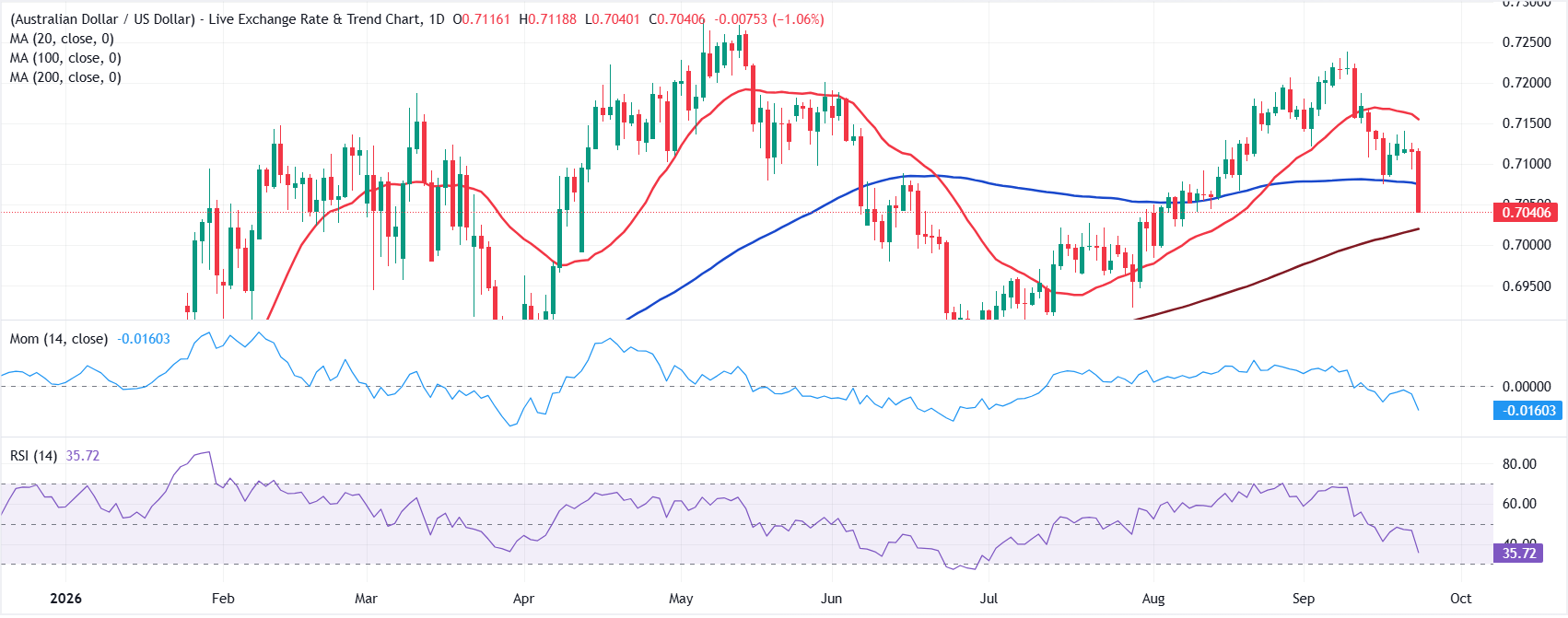
Valeria Bednarik, Chief Analyst at FXStreet, notes: “The AUD/USD pair trades around the 0.7050 region ahead of the announcement, with a clear bearish bias amid persistent USD demand. The pair is currently piercing its 100-day Simple Moving Average (SMA), which slowly turns south, reflecting continued selling interest. AUD/USD is also far below a bearish 20-day SMA currently at around 0.7160. Technical indicators, in the meantime, have turned sharply lower within negative levels, also in line with mounting selling pressure and hinting at lower lows ahead.”
Bednarik adds: “The risk of additional declines will increase if the pair breaks below the 0.7030 level, an immediate support area, while the next relevant hurdle comes at 0.6970. The first line of sellers is located at 0.7100, followed by a stronger one in the 0.7130 region.”
Employment FAQs
Labor market conditions are a key element to assess the health of an economy and thus a key driver for currency valuation. High employment, or low unemployment, has positive implications for consumer spending and thus economic growth, boosting the value of the local currency. Moreover, a very tight labor market – a situation in which there is a shortage of workers to fill open positions – can also have implications on inflation levels and thus monetary policy as low labor supply and high demand leads to higher wages.
The pace at which salaries are growing in an economy is key for policymakers. High wage growth means that households have more money to spend, usually leading to price increases in consumer goods. In contrast to more volatile sources of inflation such as energy prices, wage growth is seen as a key component of underlying and persisting inflation as salary increases are unlikely to be undone. Central banks around the world pay close attention to wage growth data when deciding on monetary policy.
The weight that each central bank assigns to labor market conditions depends on its objectives. Some central banks explicitly have mandates related to the labor market beyond controlling inflation levels. The US Federal Reserve (Fed), for example, has the dual mandate of promoting maximum employment and stable prices. Meanwhile, the European Central Bank’s (ECB) sole mandate is to keep inflation under control. Still, and despite whatever mandates they have, labor market conditions are an important factor for policymakers given its significance as a gauge of the health of the economy and their direct relationship to inflation.
Economic Indicator
Unemployment Rate s.a.
The Unemployment Rate, released by the Australian Bureau of Statistics, is the number of unemployed workers divided by the total civilian labor force, expressed as a percentage. If the rate increases, it indicates a lack of expansion within the Australian labor market and a weakness within the Australian economy. A decrease in the figure is seen as bullish for the Australian Dollar (AUD), while an increase is seen as bearish.
Read more.Next release: Thu Sep 24, 2026 01:30
Frequency: Monthly
Consensus: 4.5%
Previous: 4.5%
Source: Australian Bureau of Statistics
The Australian Bureau of Statistics (ABS) publishes an overview of trends in the Australian labour market, with unemployment rate a closely watched indicator. It is released about 15 days after the month end and throws light on the overall economic conditions, as it is highly correlated to consumer spending and inflation. Despite the lagging nature of the indicator, it affects the Reserve Bank of Australia’s (RBA) interest rate decisions, in turn, moving the Australian dollar. Upbeat figure tends to be AUD positive.